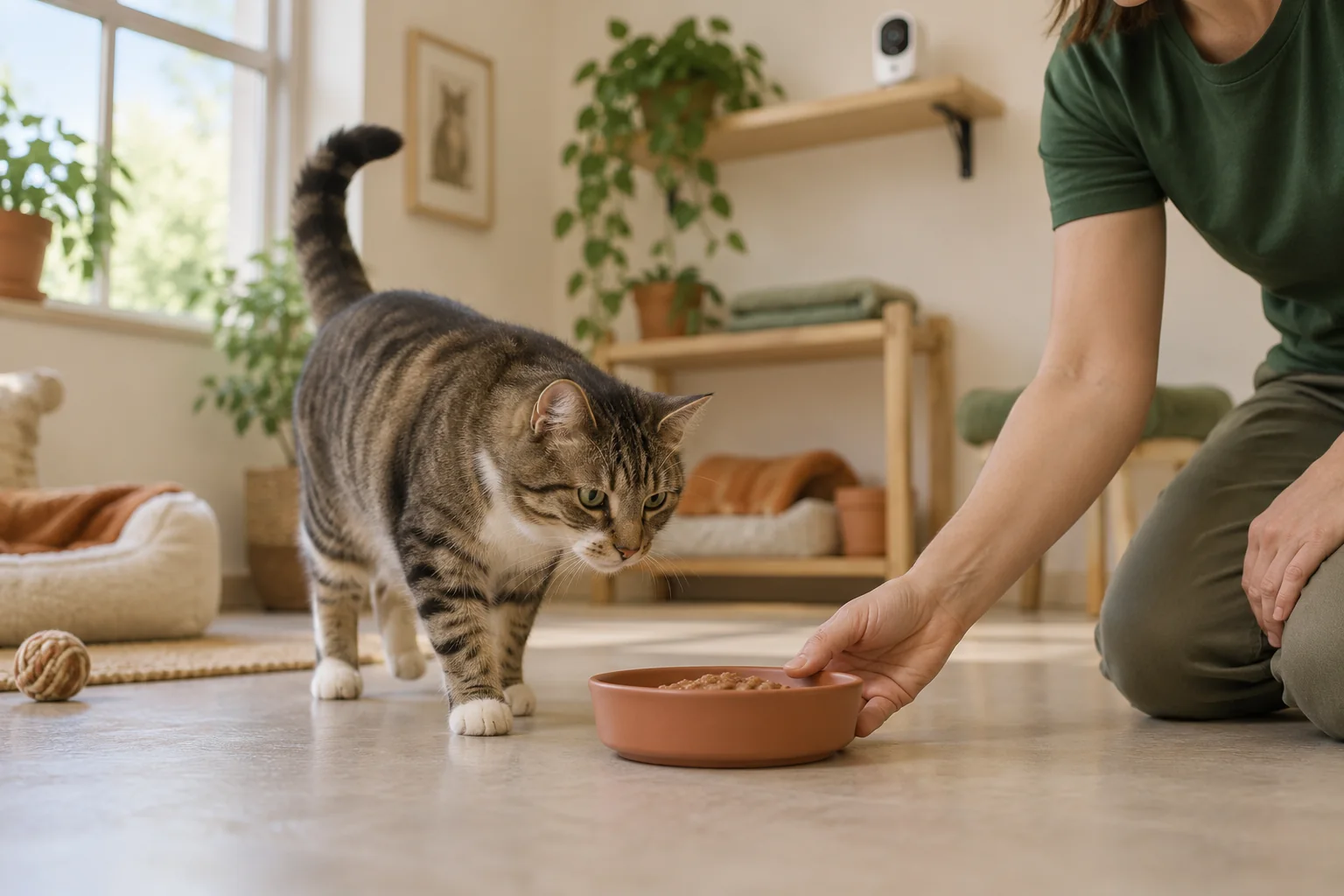
- A donation can support a scheduled feeding without giving the internet control of an animal’s diet.
- Payment received, session approved and feeding confirmed are separate events; show each accurately.
- Start with a staff-run livestream and clear donation terms before considering connected hardware.
Prepared with AI-assisted research and source checks on October 14, 2026. The proposed experience, interface and calculations are illustrative. No animal-feeding hardware or donation system was built or tested for this article; Jaden has not independently reviewed this guide.
A small donation with something you can see
Picture a rescue running a short, supervised afternoon broadcast. A supporter opens the page, meets the animals, and sees when their next planned meal will happen. They contribute $1 toward the feeding fund. During the session, a caregiver serves the approved meal and posts an update. The animal eats on its normal schedule, whether one person donates or a thousand do.
There are already examples of care becoming visible online. Teddy Food presents animal profiles, livestream access and ways to support care; Kitkat Playroom offers a kitten webcam alongside donation options. Those pages show approaches to connecting supporters with animals. They do not prove a donation-triggered feeder works, or that livestreams increase giving. [5] (opens in a new tab) [6] (opens in a new tab)
The opportunity for a small organization is a clearer connection between support and daily work. Someone can understand what happens after checkout, see the people doing the care, and return for an update. That could be worthwhile for a rescue with willing staff and an appropriate setting. It would add work, equipment and responsibilities that a simple donation page does not have.
The care plan decides when the button is available
For this concept, the rescue’s animal-care team and veterinarian would determine which animals, food, portions and sessions are appropriate. Cornell’s feline guidance explains that cats’ nutritional needs change with life stage, that food needs vary between individuals, and that a veterinarian should guide dietary adjustments. A donation total cannot supply those decisions. [7] (opens in a new tab)
I would give staff a master pause control and keep feeding limits independent of the public website. If a session reaches its approved capacity, the page should say so. It could offer a clearly described general-care donation instead, with a separate choice. It should never quietly sell another feeding or encourage people to unlock extra portions.
Animals need the option to leave the camera’s view. Staff should be able to stop the broadcast for care, cleaning or privacy without treating that as a failed performance. The page should make clear that the animals will receive their planned care regardless of donations. These are proposed operating requirements for the experience, not a clinical feeding protocol.
Follow one dollar through the system
The public page is only the beginning. A useful system needs a record connecting the donation, the scheduled session and the eventual update. Here is the sequence I would ask a builder to design:
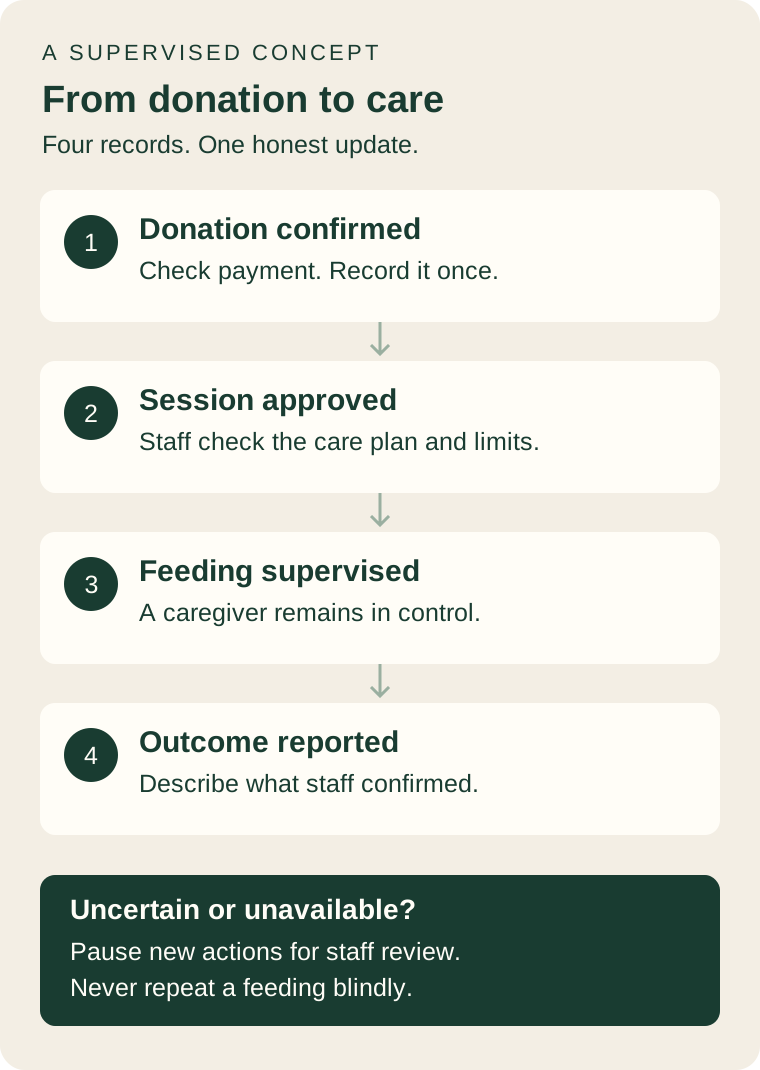
First, the server checks the payment provider’s actual payment status. A thank-you page alone is insufficient: Stripe explains that a customer can pay and then lose their connection before returning to the website. Some payment methods also finish processing later. “Payment processing” should remain visible until success is confirmed. [2] (opens in a new tab)
Next, the server records the contribution once. Stripe documents repeated event deliveries and recommends verifying their signatures. In ordinary language: the website must check who sent the message and recognize when it has already handled the same payment. A repeated notification must not create another feeding request. [1] (opens in a new tab)
Only then does the donation join the appropriate session record. Staff confirm that the session is still open and suitable. In a first version, the caregiver serves the food and marks the session complete. Supporters receive an accurate update tied to that session, without implying their individual dollar paid for a particular mouthful.
If connected dispensing equipment is added later, I would require a qualified hardware specialist to assess suitability, guarding, cleaning and independent physical limits with the care team. The device should not accept public commands directly. A missing acknowledgement must trigger staff inspection, not a blind repeat that could dispense twice. This article provides no wiring instructions or claim of hardware safety.
What the supporter sees when something goes wrong
“Live” still includes delay. YouTube describes latency as the time between an event reaching the camera and appearing to a viewer, with tradeoffs between delay and buffering. A supporter might see an update before the corresponding moment arrives in the video. The page should explain that the stream may lag. [4] (opens in a new tab)
The camera stops
Show “Video temporarily unavailable.” Keep the donation receipt accessible, and provide a staff-confirmed session update later. A frozen frame should not carry a reassuring live indicator.
The feeding is paused
Close the session’s donation option and show the reason staff can responsibly share. For existing gifts, follow the cancellation or refund policy disclosed before checkout.
Equipment gives no clear result
Show “Awaiting staff confirmation.” Stop further commands until someone checks the physical situation. A message sent to a device is not proof that food reached an animal.
The animal walks away
Let it. The camera offers a view of care, not a guaranteed performance. Do not describe food dispensed as food eaten unless a caregiver has confirmed that outcome.
I would show a session time, last confirmed status and an easy way to contact the organization. Donor names and messages should stay private unless the donor deliberately chooses a public display. Camera placement should avoid exposing visitors, staff conversations or private records. Clear text updates also let someone understand the outcome without watching the video.
Does a one-dollar gift make financial sense?
The amount makes the idea approachable, but small card payments deserve a calculation. Stripe’s standard US price checked for this guide is 2.9% plus 30¢ per successful domestic-card transaction. Using that rate, a $1 gift leaves about $0.67 after payment processing; a single $10 gift leaves $9.41. Ten separate $1 payments leave about $6.70. These are illustrative calculations, not a quote for a particular organization. [3] (opens in a new tab)
That remaining amount still has to cover whatever the organization promises. Food is only one consideration: staff time, a camera, reliable connectivity, equipment upkeep, website maintenance and donor support may also matter. Country, card type, account pricing, refunds and other charges can change the result. Check the actual provider agreement before setting donation amounts.
A reasonable pilot could keep $1 as an optional contribution while explaining larger gifts and general-care support clearly. Avoid a prepaid “feed credit” system in the first version: it creates another balance to administer and expectations about when credits can be used. Never promise a complete meal for a dollar without a defensible cost basis.
Start with a session, then decide what to automate
My starting version would use an existing donation checkout, one staff-run broadcast and a small page with the next session, a plain description of fund use and an honest status update. Confirm that the organization’s accounts, stream and terms permit the intended use. Rehearse with simulated payments and no automated animal interaction before accepting gifts for the experience.
- Agree on the care plan, staff owner, camera boundaries, donation terms and what happens if a session is canceled.
- Rehearse a successful payment, a delayed payment, a repeated notification, a camera outage and a stopped session.
- Confirm that staff can pause the experience immediately and that donors can still find their receipt and support contact.
- Review net donations, staff minutes, donor questions and care-team observations after a small pilot.
Those measures answer a better question than whether the stream attracted views: did the experience help supporters understand the work, raise useful funds and fit comfortably into animal care? Do not infer success from one unusually busy broadcast. Keep a simple donation option available for people who prefer it.
The transferable website idea is connecting a promise to an operational record and a clear confirmation. The Vanta Booking project linked below shows a booking-and-confirmation workflow; it is not an animal-care installation. A donation experience would need its own design and specialist review.
If you have an idea that connects your website to something happening in the real world, start with the moment you want a visitor to understand—and the person responsible when it goes wrong. That is enough to begin scoping a useful first version.
Sources & further reading
Sources used in this guide. Checked October 14, 2026. Study dates and scope are shown where they affect the interpretation.
- 01Stripe webhook delivery and verification (opens in a new tab)Stripe
Official documentation: verify payment events, expect retries and duplicates; these are software events, not evidence of physical feeding.
- 02Fulfill payments with Checkout (opens in a new tab)Stripe
Official guidance on checking payment status, server-side fulfillment, repeated calls, and delayed payment methods.
- 03United States standard payments pricing (opens in a new tab)Stripe
Domestic-card example checked October 14, 2026: 2.9% plus 30¢. Actual country, account, payment-method and additional fees can differ.
- 04Understand live streaming latency (opens in a new tab)YouTube Help
Official explanation of camera-to-viewer delay and the buffering tradeoff. No latency guarantee for the proposed system.
- 05Help shelter animals online (opens in a new tab)Teddy Food
The public site pairs animal profiles, livestream access and ways to support care. Its outcomes and operation were not independently audited.
- 06Kitkat Playroom (opens in a new tab)Kitkat Playroom
The rescue's own page presents a kitten webcam and donation options. It does not establish that donations trigger a feeder.
- 07Feeding Your Cat (opens in a new tab)Cornell Feline Health Center
Veterinary guidance updated April 30, 2026: nutritional needs vary, and a veterinarian should guide appropriate feeding. Not an endorsement of connected feeders.